
Peak season doesn't end when the selling stops

In October, back-to-school returns are still landing while the team is already building the Black Friday plan. In January, new orders come in from the sales at the same time as unwanted Christmas gifts are being returned. Between September and January, fashion ecommerce undertakes some of the most important shopping periods one after the other, and the returns from each one keep arriving well into the next.
How much does fashion represent for ecommerce sales across Europe?
Fashion accounts for around 20% of online spending across Western Europe, according to the latest NIQ report on European fashion ecommerce in 2026, which covers ten markets, including the UK, France, Germany, Italy and Spain, and analyses the behaviour of more than two million online shoppers.
Over the past year the European market grew by 5%, against 3% for online fashion sales. The category is still growing, but at a slower pace, in a market that is maturing and fragmenting at the same time.
In April 2026, 29.3% of UK clothing sales were made online, according to the Office for National Statistics.
The increase in demand is a major test for the teams managing orders, deliveries, exchanges and returns. And during the final months of the year, all of those processes start to overlap.
Which sales periods fall between September and January?
Several of the biggest moments in the retail calendar sit between September and January. Each campaign focuses on selling something different, a school uniform, a costume, a winter coat, a gift for someone else, and each one is bought in a different way, but they all generate work before, during and after the peak.
Back-to-school
UK families spend an average of around £300 per child on back-to-school shopping, according to Nationwide research reported by Confused.com. On top of that comes uniform, still one of families' main spending concerns according to Save the Children UK's Big Summer Survey 2026.
In kidswear, getting the size right is particularly difficult. Children grow, sizing varies between brands, and a garment that fitted last school year may not fit a few months later. When a parent orders several sizes of the same item to be sure, that order is very likely to generate a return. It is also the kind of return a brand can prevent.
Back-to-work
The return to the office overlaps with back-to-school and creates a different kind of demand for fashion brands. Many people use these weeks to refresh part of their work wardrobe, particularly as the seasons start to change.
It is also the period that gets talked about least and measured least, despite coinciding with one of the highest-volume moments of the year.
Fit matters here too. Knowing how a garment will look, whether the cut works, whether it will still be comfortable at six in the evening: none of that is easy to judge from a product page.
Halloween
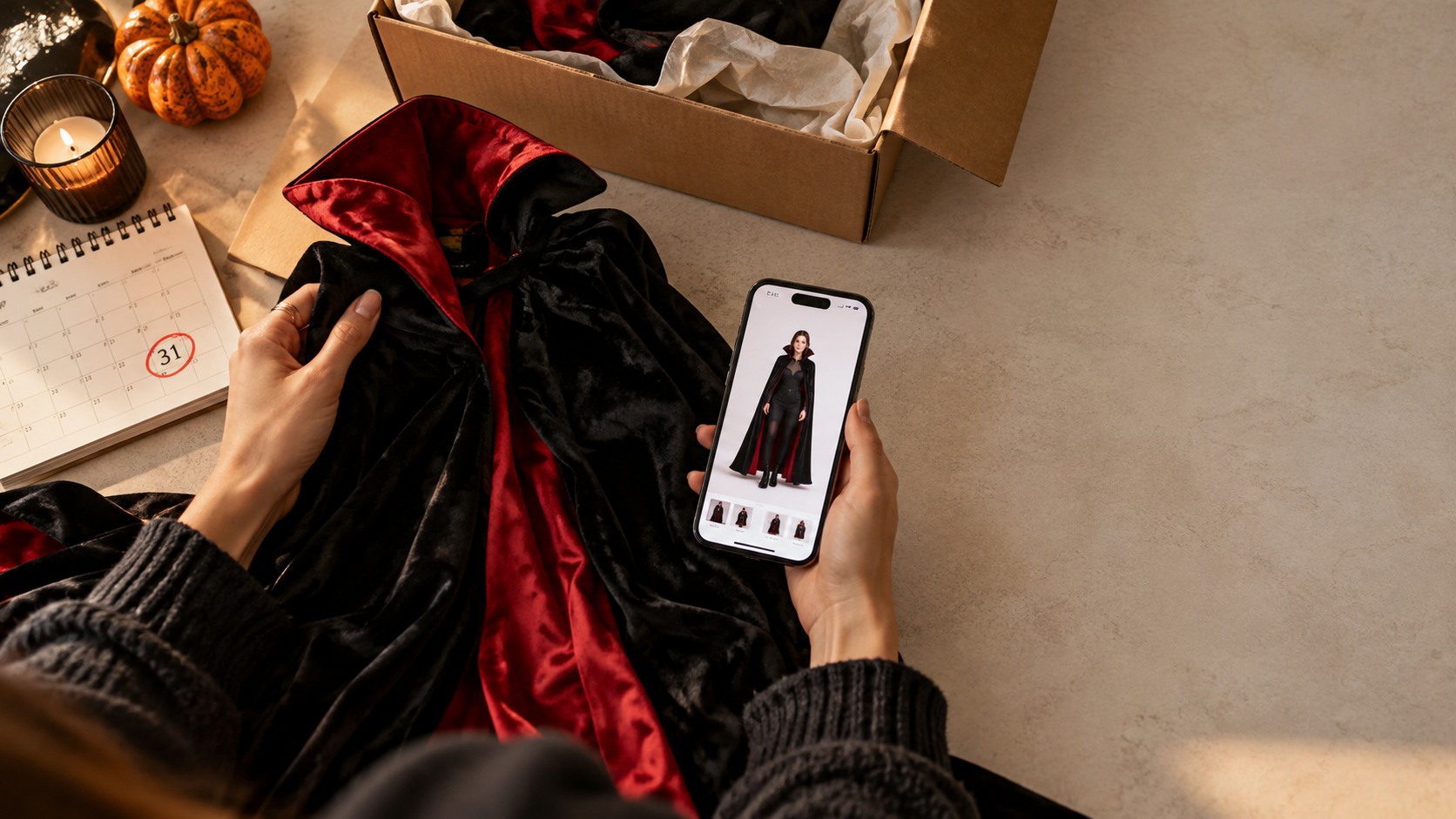
Interest starts to build through September and purchases concentrate in the final weeks of October. GlobalData forecastUK Halloween spending at £537 million last year, 3.2% up on the year before, and found that 60% of Halloween shoppers planned to spend less than they had previously.
Unlike other moments in the calendar, this one has a very specific date and very little room to fix anything that goes wrong.
If a costume doesn't fit, arrives late or isn't what the customer expected, the return can land after Halloween is already over. The product comes back in perfect condition, to a window in which it can barely be sold.
Black Friday
Then comes the biggest peak of them all. In the UK, PwC forecast that spending during last year's Black Friday would reach £6.4 billion, with an average of £262 per person, 13% more than the year before. On the same forecast, 80% of that spend would go online, either for home delivery or click and collect.
Order volume concentrates into a few days, but returns from those purchases keep arriving through December and January, long after the period itself has closed.
Christmas
Most of what gets bought in December is a gift, and that shapes the returns that follow. Whoever picks the size isn't the person who will wear the garment, so they are deciding for a body that isn't theirs, with no way of checking how it will look. The parcel isn't opened when it arrives either, it sits waiting until the 25th.
All of this happens at the biggest spending moment of the year. UK Christmas spending rose 3.6% last year, and online grew far faster than physical retail, 5.8% against 2.1%, according to Visa's Retail Spend Monitor.
What sets December apart is the delay. Normally the customer receives an order and decides within days, but here three weeks can pass between the gift being bought and being opened. December purchases don't come back in December. They come back in January, while Black Friday returns are still arriving.
Winter sales
January tends to be seen as the returns month, and it is a good deal more than that. There are new orders, because the sales are a serious selling moment in their own right. There are Black Friday returns, which have been arriving for weeks. And there are Christmas returns, which have only just started.
The dates move too. In the UK the sales start on 26 December, in Germany they run until 31 January, and in France they open at the beginning of the month and last four weeks, according to the European Consumer Centres Network. Sell across several markets and they never begin at the same time in any two of them.
As with Black Friday, discounts encourage bracketing: when something is half price, ordering two sizes costs less. So January brings in new volume while November and December are still coming back, and an autumn garment that returns now arrives untouched to a catalogue that has already been marked down.
Why do fashion sales peaks overlap?
They overlap because orders and returns don't follow the same calendar.
After receiving an order, the customer still has to decide what to send back, pack it and hand it to the carrier. The product then has to reach the brand, be checked and be processed before it can be sold again. Depending on the carrier and on each ecommerce's own process, several weeks can pass between a return being started and that unit going back into stock.
That is why purchases from one peak keep generating work once the next has begun. Back-to-school returns arrive through October, while Halloween is already underway. Halloween returns land in November, alongside Black Friday. Black Friday returns keep coming through December and January, just as Christmas gifts start going back. And Christmas returns run into the new orders from the sales.
Sales peaks last longer and sit closer together every year, but returns keep to their own pace.
For an ecommerce team, that means preparing for Black Friday while still processing Halloween returns, or handling Christmas returns in the middle of the sales.
Not every return carries the same weight, either. In kidswear the issue is usually sizing, in adult fashion it is fit, and with Halloween what matters most is when the product comes back, because that decides whether it still has any commercial value at all. At Christmas, the person returning often isn't even the person who bought it.
How does all this affect inventory?
The problem doesn't stop at customer service. It reaches inventory, because a return doesn't automatically become available to sell again.
It has to reach the warehouse, be checked and be processed first. Until then, that unit sits outside available stock.
During a peak, those days count. An autumn garment that goes back into stock in December no longer has the opportunity it had in October. The same goes for a Halloween costume that comes back after 31 October: perfect condition, and no occasion left to sell it into.
So it isn't enough to know how many returns a brand receives over these months. You also need to know how long a unit takes to become available to sell again, and how much stock is sitting out of circulation while that happens.
How do you prepare to run several sales periods at once?
One of the first things an ecommerce team can do is look at the sales calendar and the returns calendar together. If the order peak is expected in certain weeks, the returns from those purchases can be estimated too.
That makes it possible to see in advance where two periods will collide, and to plan capacity across customer service, warehouse and logistics accordingly. It isn't only a question of how many orders to expect, but of how much work those orders will generate in the weeks that follow.
Measuring how long a return takes to become sellable again is worth the effort as well. There is a real difference between a unit taking a few days and taking several weeks, especially with seasonal stock, and that figure is usually where the delays show up first.
Return conditions can be reviewed period by period. A Halloween costume, a school shirt and a winter coat have different selling windows, so it doesn't always make sense for all three to follow the same process.
Preparing for a sales peak means looking beyond order volume and being clear about what happens to those orders once they start coming back.
How does Reveni help during these seasons?
Reveni cuts some of the delays that create the most pressure during these months, particularly when several sales periods are running at once.
Instant ships the exchange before the returned item arrives. The customer stops waiting on the first garment to receive the second, and the returned unit goes back into stock sooner.
With the Policy Rules Editor in Global Returns, teams set different return conditions by period or by product without handling each case manually: one set of conditions for Halloween, another for the autumn collection.
Tailor works before the return exists, answering the question that causes it. A customer asking whether a coat runs large gets a straight answer at the point of choosing the size, and that doubt stops reaching the operations team three weeks later as a parcel.
Smart Tracking covers the wait in between. During a peak, delivery times stretch and the "where is my order" question multiplies, so the tracking page becomes the one the customer visits most. Keeping it on the brand's own site, updated, takes that question off the support queue before it is asked.


.png)