More than half your returns are decided before the customer buys
Returns are part of how fashion sells online, and the number on its own says very little without what sits behind it: why the items come back, what each one costs to handle, and what the whole process does to the relationship with the customer. Across Europe and the UK there is no official measurement, only a handful of studies with known methodologies, and read together they give a reasonable picture of the size of the problem. Here is what they say.
More than half your returns are decided before the customer buys
Not in the warehouse, and not in transit. On the product page, when someone hesitates between two sizes, cannot tell how a garment will fall, or decides to order both and try them at home.
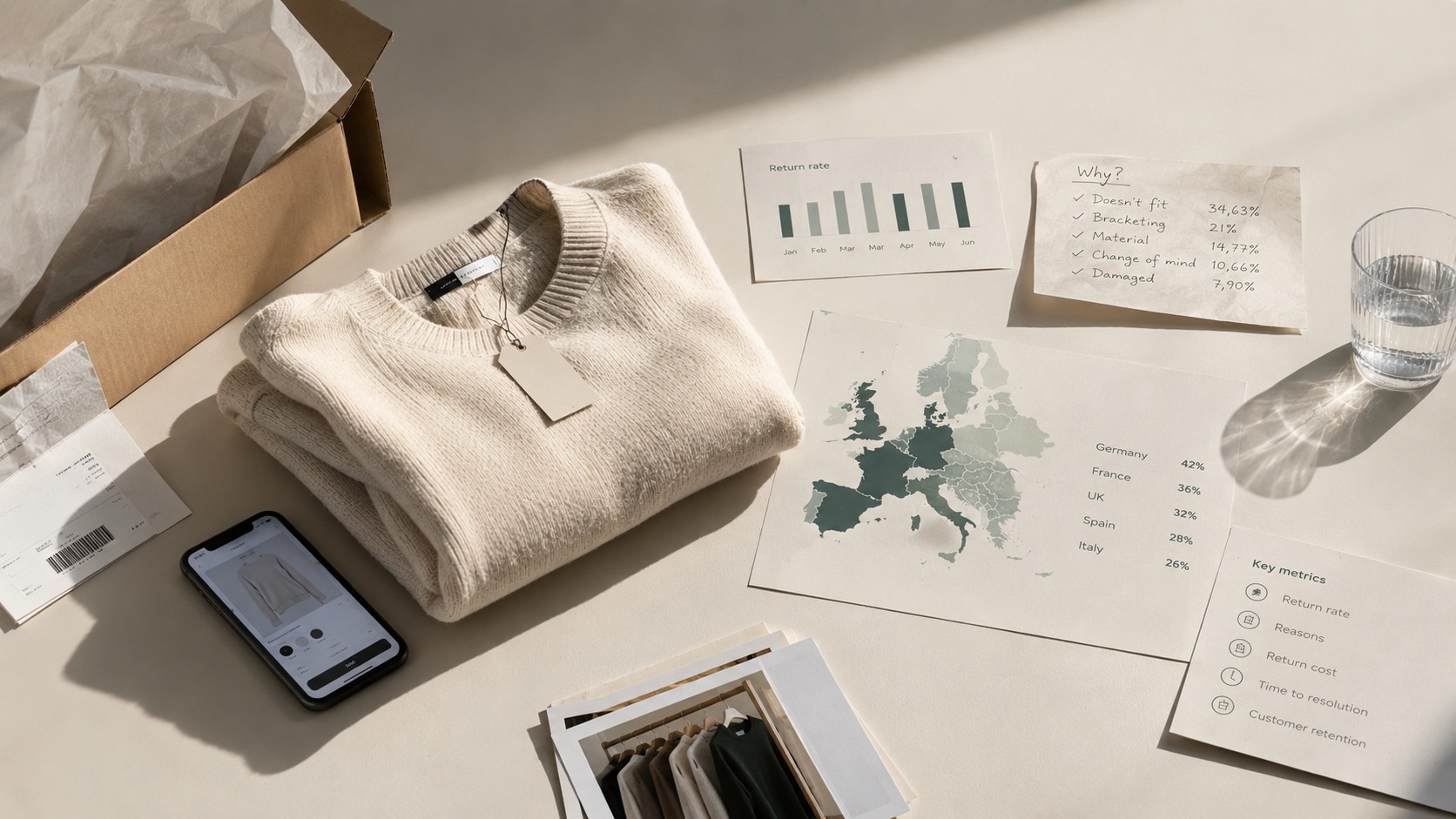
According to our report The state of returns, 34.63% of fashion returns happen because the garment does not fit, and another 21% come from bracketing: ordering several sizes to see which one works best.
Between them, that is more than half of every return we analysed. The two behaviours are different, but they share the same root, which is uncertainty at the moment of purchase.
So understanding returns starts long before the parcel comes back to the warehouse.
How much gets returned in online fashion?
Look for a return rate for fashion and the figures vary wildly. There is a reason for that: nobody measures this officially in Europe. National statistics offices do not publish return rates, so everything in circulation comes from one-off studies or from companies in the sector. What does exist is a set of specific studies, with known methodologies, enough to get a sense of the scale and of how much markets differ.
Germany, Austria and Switzerland
The EHI Retail Institute surveyed 124 online retailers across Germany, Austria and Switzerland in 2025. Of the fashion retailers, 24.5% reported rates of between 36% and 50%, and 12.2% were above 50%. In electronics, 85.7% stayed below 10%.
The UK
In the British market, clothing and footwear also carry significant weight within online returns. A study published in Transportation Research puts clothing and footwear at 19.9% of all ecommerce returns.
Fashion carries weight in the country's online sales too. According to the Office for National Statistics, 29.3% of clothing sales were made online in April 2026, which makes it one of the most digitalised categories in UK retail.
Among shoppers, a fulfilmentcrowd survey reported by Just Style found that the average British customer buys 22 garments online a year and returns six, a return rate of around 30%.
The same research cites Retail Economics: frequent returners generate £6.6 billion in online returns every year.
Why fashion returns more than any other category
Buying fashion online means deciding on size, fit and how a garment falls without being able to touch it. No other category asks so much of the customer with so little information.
Which is why your return rate tells you far more against your own history than against a sector average or an electronics retailer.
Why do customers return fashion items?
Customers return fashion mainly because the garment does not fit the way they expected, because they ordered several sizes to choose from, or because the product did not live up to the product page.
According to our report The state of returns, the main reasons are:
Read together, those figures say something specific: part of the return is decided before the customer pays.
If someone has no reliable information about how a garment is sized, how it fits or how it will actually look, ordering two sizes is the reasonable thing to do. The return is then the consequence of a decision made on incomplete information.
So reducing returns is not only a logistics job. It also means helping the customer decide with more confidence before they buy.
What is bracketing in online fashion?
Bracketing is buying several sizes, colours or versions of the same product with the intention of trying them and returning the ones you do not want to keep.
It is particularly common in fashion because the customer cannot try the garment before buying it. Ordering one size up and one size down looks like the easiest way to make sure something fits.
In our data, bracketing accounts for 21% of returns.
And it is not an isolated habit. In the Consumer Barometer published by KPMG and IFH Köln in December 2025, almost half of consumers said they deliberately order several items so they can choose.
It does not always mean the customer is unhappy with the product. Often it simply reflects the uncertainty that exists at the point of purchase.
For the brand, that uncertainty has a cost: more shipments, more parcels to process, more stock in transit and more chances that a garment is unavailable for another customer.
There is a way to bring it down that does not involve making returns harder. In the fulfilmentcrowd research, 83% of British consumers said they would limit bracketing if they had more information before buying. But it works from the other end too: when the exchange is fast enough, ordering two sizes stops being worth the trouble, because the customer no longer needs to hedge.
How much does it cost to process a return?
The cost of a return is not the price of the shipping label. For an ecommerce business, every return means transport, collecting the parcel, inspecting the product, reconditioning it, processing the refund and, in some cases, losing value on the stock.
Estimates put the direct cost at between €10 and €25 per return, though it varies considerably by market and product type. With a range that wide, the only useful figure is your own.
The cost is not only financial, either. How long a return takes matters too.
According to the EHI Retail Institute, 43.4% of the retailers surveyed process returns within one or two days, while another 26.2% take three or four.
That refers to processing, not to the full cycle. For the customer, the process starts when they request the return and ends when the refund or the exchange lands. For the brand, every day a garment spends in transit or waiting to be processed is a day that product is not available to sell again.
In fashion that time costs more than in any other sector. A seasonal garment loses value on the way back, and by the time it reaches the warehouse it may only sell at a discount.
Is a low return rate a good sign?
It depends on why it is low. If returning is complicated or expensive, some customers end up keeping something they never wanted. The return never appears in your data, but the problem is still there.
The KPMG data shows exactly that: 36% of consumers say they keep products when the return process is too complicated.
A low rate can hide a bad experience. Alongside how many returns we have, it is worth knowing what is happening with the customers who never file one.
The experience shapes the relationship with the brand too. In our report, 91.39% of consumers say they would not buy again after a bad returns experience, and 93.43% consider a simple process decisive when making a first purchase.
Which is why cutting returns at any cost can be the wrong strategy. The aim should be to prevent the ones that are preventable and make the ones that do happen simple and fast.
Which returns metrics should I track?
The return rate still matters, but it should not be the only one. To understand its real impact, it helps to look at what happens before, during and after each return.
And part of that impact is not in your data, it is in somebody else's. A return is the one point in the journey where the customer decides in public whether they trust you, because it is when they write the review. Nobody reviews an order that arrived fine. And that relationship is now shifting both ways: in 2026 Asos started showing each customer their own return rate, so the data has stopped belonging only to the brand.
Will returns keep being a problem in online fashion?
Yes. Returns are part of how fashion is bought online and they are not going away. What can change is how you handle them.
The goal is not to make returns disappear. It is to reduce the ones that come from a customer not knowing enough before buying, and to take the point out of bracketing by making the exchange fast enough that ordering two sizes stops being worth it. For the ones that happen anyway, the goal shifts: a process that works builds trust with the customer going through it, and with the ones who have not bought yet and are reading the reviews to decide whether to.
A return does not have to end a relationship with a customer. Handled well, it is one more part of the shopping experience.
We go into this in our returns and loyalty playbook, made with LoyaltyLion, Swanky, Leat, Loyoly, Domaine and Limesharp.
Frequently asked questions about online fashion returns
Why do customers return clothes bought online?
The main reasons come down to size and fit. According to Reveni's report The state of returns, 34.63% of returns happen because the garment does not fit and another 21% come from bracketing. The rest split between problems with the material, changes of mind and products that arrived damaged.
What is bracketing?
Buying several sizes, colours or versions of the same product to try them and return the ones you do not want to keep. It accounts for 21% of fashion returns, and KPMG and IFH Köln found that almost half of consumers do it deliberately.
How much does it cost to process a return?
It depends on the retailer, the market and the product type. Estimates put it between €10 and €25 once transport, processing, inspection, repackaging and customer support are counted. The range is wide enough that the only reliable figure is the one you calculate for your own operation.
Which metrics should a brand track to manage returns better?
Beyond the return rate: cost per return, the share of exchanges against refunds, resolution time, how long the product takes to become available again, and the repurchase rate after a return. And three almost nobody looks at: how many negative reviews are about the returns process rather than the product, how many exchanges fall through because the size sells out while the parcel travels back, and how many customers buy again before the return has even reached the warehouse. With Reveni's Global Returns you can track the reason behind each return and the time back to stock.