Notify the customer and claim from the carrier at the same time
One of your orders stops updating on 2 December. The customer who bought it writes to your customer service team, who reply and offer to send it again because they don’t know what has happened to the order, and the case is closed. That parcel never turns up, and that’s when the carrier becomes liable, but nobody knows exactly how to claim for that order. Nobody knows what the deadlines are or how to go about it. So, to shed some light on the problem, in this post we walk you through how to stop it happening.
Brands pay twice
When a parcel is lost, the brand pays twice for the same order.
First, it pays to resolve the customer’s issue. It sends the product again or refunds it, because it isn’t the customer’s fault the parcel went missing.
Second, it absorbs the cost of the lost parcel. The product and the shipping were already paid for, and that money only comes back if someone claims it from the carrier. If nobody does, the brand loses it.
And it isn’t carelessness, because claiming takes time. You have to log into the carrier’s portal, gather evidence, open the case and wait for them to pay. In a normal week it’s hard enough. In Black Friday week it’s impossible.
What it costs the brand
Losing a parcel isn’t unusual. In the UK, 16% of consumers had a parcel that never arrived in just six months, and 15% received a damaged one. The figures come from Ofcom’s 2025 report on parcel delivery, based on a survey of more than 4,000 adults.
And when it happens, the customer doesn’t blame the carrier, they blame the brand. 42.46% of European shoppers hold the online store responsible for delivery problems, even when the carrier is the one delivering. And 29.06% didn’t buy from that shop again after a failed delivery. That’s according to Sendcloud’s E-commerce Delivery Compass 2026, covering 8,000 shoppers across eight European markets.
There’s also a cost nobody sees. A lost parcel that nobody claims doesn’t appear in any report. Nobody logged it as pending, so nobody misses it.
What you can claim
More than most people think, and not just on the outbound shipment.
Delay is the exception. Most carriers don’t publish a window for claiming it, and some, like DHL Express, explicitly exclude liability for late delivery. It’s worth knowing before you promise a customer anything.
The window doesn’t start when you find out
Of the fourteen carriers we’ve reviewed, nine start the claim window when the parcel leaves the warehouse, not when you’re told it’s lost. So by the time the customer writes in asking about their order, part of the window has already gone, and if the claim waits until the ticket is closed, there may be nothing left.
On top of that, several carriers won’t accept a claim until they’ve declared the shipment lost. Royal Maildoesn’t do this until 10 working days after the expected delivery date for domestic shipments, and that wait comes out of the same window rather than being added to it.
And every carrier has its own rules. Windows range from 7 days for concealed damage with some Spanish carriers to 9 months with FedEx. They count from different moments and change by country, even within the same group, as with DHL or GLS. For the brand, that means not knowing how much time is left on each shipment or having any control over what slips through. With several carriers at once, a single rule for your operations doesn’t work, and the window that counts is the one in your contract.
No evidence, no claim
Arriving on time isn’t enough. Many claims never get processed because there’s nothing to prove what happened, and that’s decided on the day of delivery, not the day you claim.
Visible damage has to be noted on the delivery note in front of the driver. SEUR, DHL Parcel Spain, bpostand GLS all require it, and FedEx goes further. Under its terms, a delivery note signed without any notes counts as proof that the shipment arrived in good condition. The customer signs without looking and the claim is already lost.
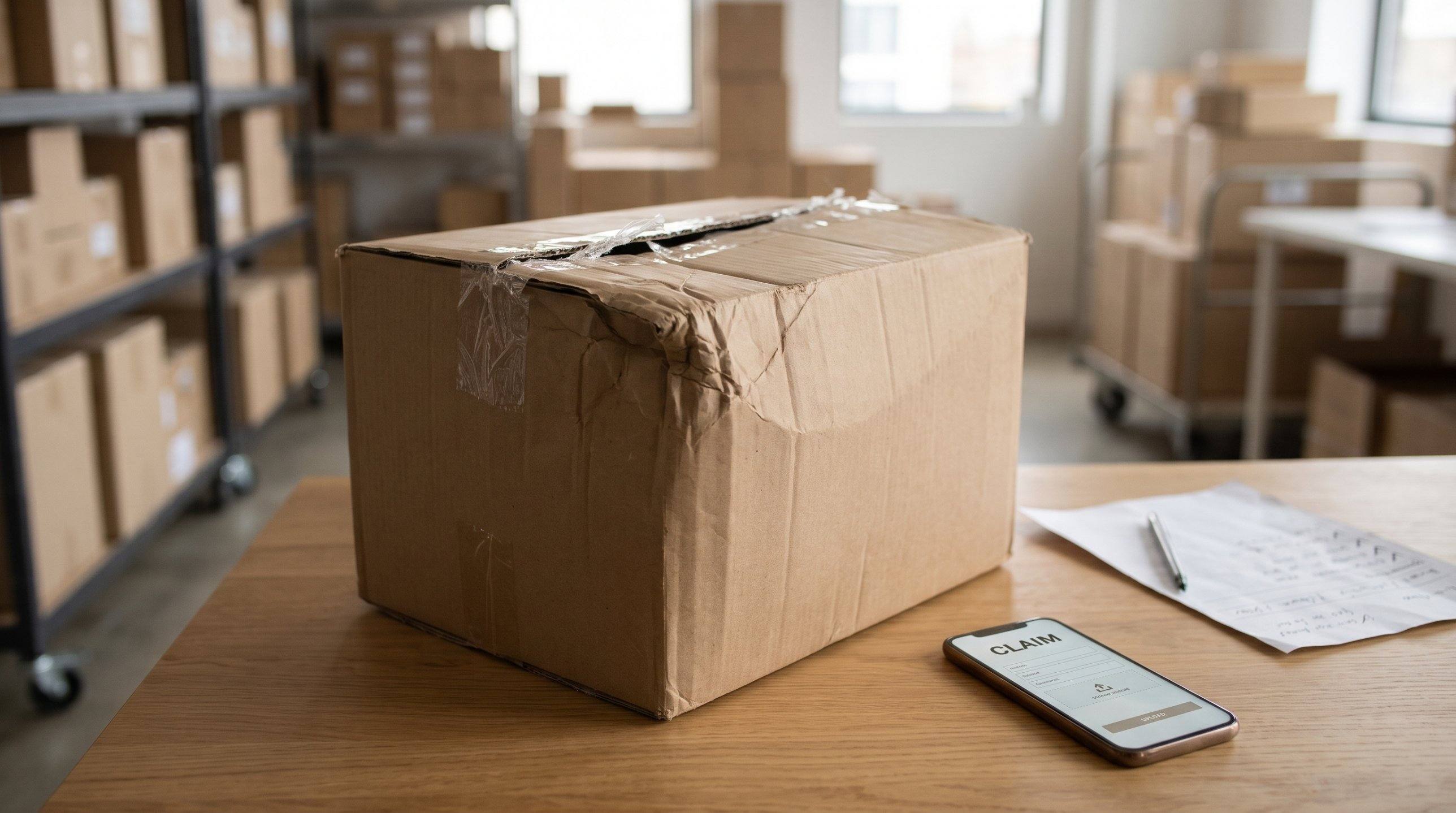
Then there’s the packaging. Royal Mail asks you to keep both the packaging and the contents, and SEUR needs them to assess the damage. A broken parcel that’s already in the bin can’t be claimed.
For shipments to the customer, this depends on whoever receives the parcel. So it’s worth asking them, in the notification itself, to check the box before signing and to keep everything until the case is closed. For returns it depends on your warehouse, and there you can turn it into a procedure.
Notify and claim at the same time
If the customer notification and the carrier claim come from the same event, which is the stalled shipment, nobody has to choose between the two.
The notification
With Smart Tracking, a stalled shipment is detected before the customer notices, and the notification comes from the brand, on its own domain and in its own tone, instead of from the carrier. The customer always knows what’s happening with their order and doesn’t have to write in to find out. In our data, proactive notifications cut “where is my order?” contacts by 45%.
The claim
With Carrier Claims, that same stalled shipment is flagged as claimable while the carrier’s window is still open, with the documentation ready for the team to approve. Nobody has to log into each carrier’s portal or add it to the December to-do list, and the money the carrier owed goes back to the brand instead of going unclaimed.
Because both are on the same platform, the notification and the claim come from the same data. The customer is kept informed and the brand recovers what it’s owed, without two teams chasing the same shipment separately. That’s what keeps operations coordinated in the busiest weeks.
And the customer, in the meantime
With Protect, a customer who added protection at checkout doesn’t depend on the carrier when their shipment is lost, damaged or stolen. Seel, our protection partner, validates the case and refunds them directly, and the claim never reaches your team.
Smart Tracking and Carrier Claims work for returns too. Smart Tracking follows the shipment back to the warehouse, and Carrier Claims also flags what’s claimable on the return label, which the brand paid for just like the outbound one.
Frequently asked questions
How long do you have to claim for a lost shipment?
It depends on the carrier and runs from 7 days to 9 months. When it starts counting matters more than how many days it is. In most cases it begins when the parcel leaves, not when it goes missing.
Can you claim for a delay?
Hardly ever. Most carriers publish no window for delay claims and some explicitly exclude liability for late delivery. What you can really claim for is loss and damage.
What if the damage isn’t visible when the parcel arrives?
Nearly all carriers separate visible from concealed damage. Visible damage has to be noted on the delivery note at the point of delivery, and concealed damage usually has a short window, 7 days with several European carriers. Keeping the packaging is part of the evidence.
Can you claim for a lost return as well?
Yes. A return label is a shipment like any other and the same terms apply. It’s the leg that gets claimed least.